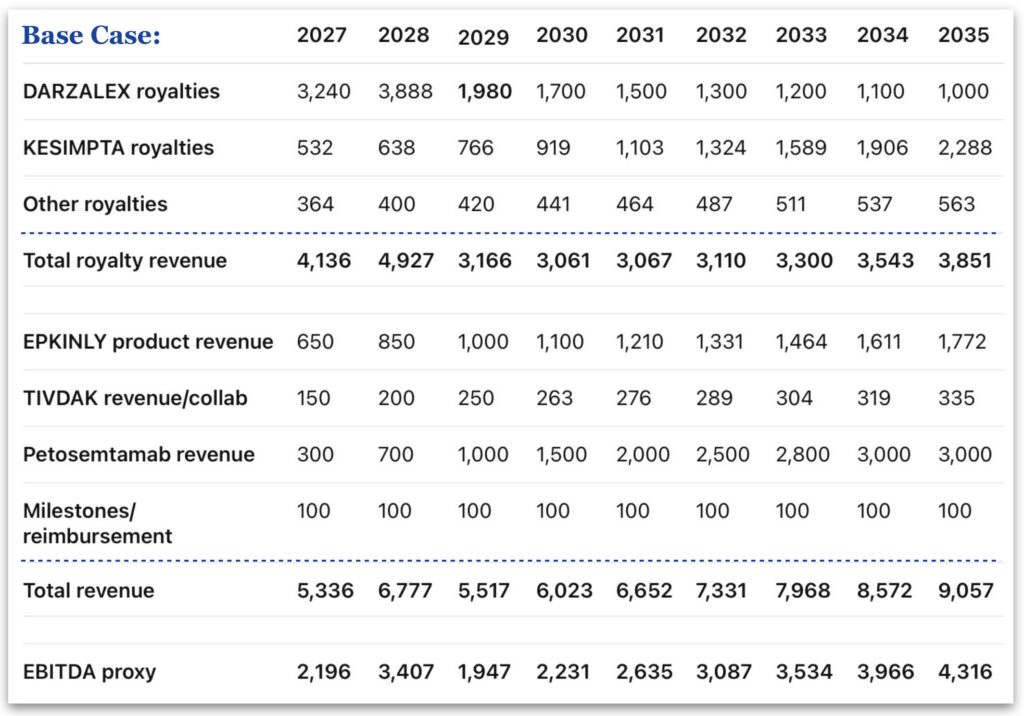
Genmab states that Darzalex/Faspro royalties are reduced in territories without patent coverage and that the U.S. patent expiry causes a material decline, not necessarily an immediate 100% loss of U.S.-related royalties. The patent dates disclosed by Genmab are years, not exact calendar dates. No specific patent-family expiry data; Genmab’s official language is simply “U.S. 2029, Europe 2031.” A best estimate provides the following Dara royalty stream (in total $12.3 to 13.1 billion, with possibly another $4.6 billion after that):
- 2027: $3.2 bln
- 2028: $3.9 bln
- 2029: $2.0 –2.4 bln
- 2030: $1.7–2.0 bln
- 2031: $1.5 –1.8 bln.
Assumptions:
- DARZALEX — the important part. Genmab received $2.443 billion of DARA royalties in 2025 and guides to ~$2.7 billion in 2026. Its royalty rate is tiered at 12–20% of J&J net sales, subject to the Halozyme-offset and patent-related reductions. 2027–28: +20% annual royalty growth / 2029: roughly $2.0 bln, representing the U.S. patent cliff / 2030–35: gradual erosion rather than a complete zero: $1.7bn → $1.0bn
It’s intentionally conservative after 2029. Genmab says its royalty obligation is country-by-country and that decline begins materially in 2029; it does not say royalties suddenly drop to zero.
- Kesimpta. I used 20% annual growth. That’s aggressive but realistic: Kesimpta royalty revenue grew from $323 mln in 2024 to $443 mln in 2025, and Genmab identifies Kesimpta as one of the main drivers of royalty growth. The model therefore gets to $2.3 bln of annual Kesimpta royalties by 2035.
- Rybrevant. I have put Rybrevant into “Other royalties”, rather than pretending I can precisely isolate its royalty contribution from Genmab’s disclosed figures. Genmab’s 2026 revenue guidance explicitly lists Rybrevant among the royalty products alongside Kesimpta, Tepezza, Tecvayli, Talvey and Epkinly/Tepkinly.
- Epkinly. I model Epkinly as a product-revenue ramp to $1.8 bln by 2035. Genmab reported $379 mln of U.S./Japan net product sales in 2025, while global Epkinly/Tepkinly sales were $468 mln. The key upside is earlier-line follicular lymphoma expansion: Genmab reported U.S. approval of Epkinly with R2 in earlier-line FL in 2025.
- Petosemtamab. Here’s the biggest judgment call. I model: $300 mln in 2027 → $1 bln in 2029 → $3 bln in peak sales. The $1 bln 2029 milestone is broadly consistent with Genmab’s stated expectation around the Merus acquisition: “A major late-stage opportunity.” Ánd it’s Genmab-owned product revenue.
The really interesting potential upside is that the biology is not simply “LGR5 is expressed in lots of cancers.” Peto is designed to hit EGFR+ tumor bulk while also targeting LGR5+ stem-like cells, with the underlying rationale particularly strong in colorectal cancer. Published work explicitly discusses LGR5+ cells as contributors to tumor growth, treatment resistance and metastasis, and points to metastatic CRC as a potential expansion opportunity.
If Peto proves that it can meaningfully control established metastatic disease — not merely produce responses in a few LGR5-positive tumors — $3 bln becomes a base-case peak-sales number. And $5 bln becomes plausible if CRC works and the mechanism generalizes to at least one or two additional large solid tumors.
The Dara cliff could be real and the royalty trough is conservative in 2029–2030. The key observation is that royalty revenue does not really grow again until 2033, despite Kesimpta growth. The entire Genmab thesis becomes a replacement thesis: Dara → Kesimpta + Epkinly + Peto (with Peto doing a lot of the heavy lifting).
Rina-S success materially changes the investment perspective. It’s the asset that makes post-Dara transition much more convincing. Genmab currently identifies Rina-S as a late-stage, wholly owned asset with >$2 bln peak annual sales potential and expects potential first launch in 2027 (key Phase III readouts are expected in 2H2026). Here’s the Updated Base Case — including successful Rina-S:
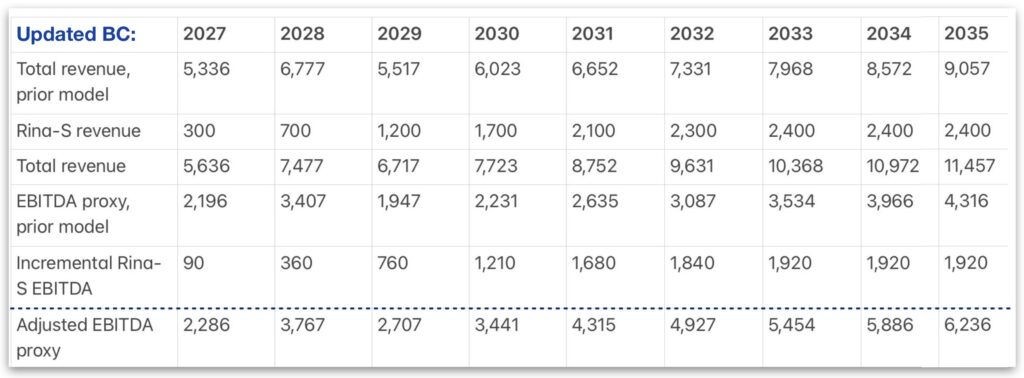
The crux is that Rina-S changes the 2029 story completely. The Dara cliff is still visible, but is no longer a major earnings event. By 2031, Genmab reaches approximately $8.8 bln revenue / $4.3 bln EBITDA. And by 2035: $11.5 bln revenue / $6.2 bln EBITDA. The Genmab story becomes much more asymmetric if both Rina-S and Peto work.
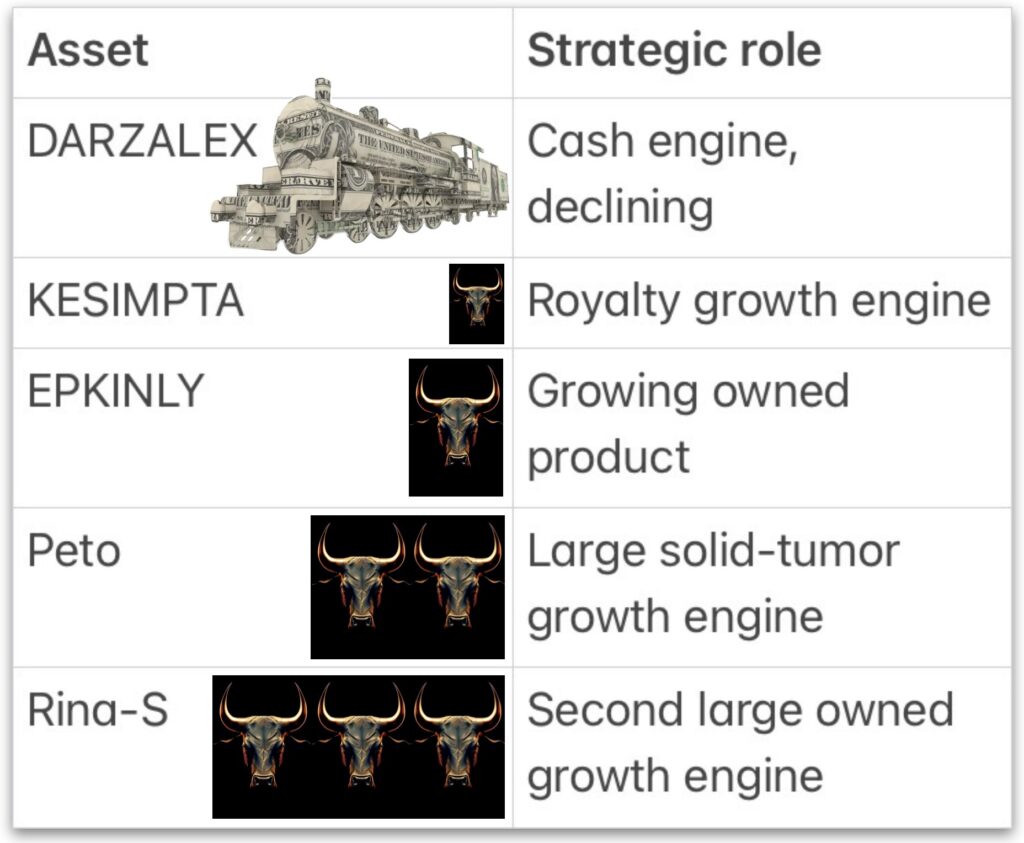
An important point: Rina-S is potentially more valuable to Genmab than its peak sales alone suggest. It is 100% owned, and it directly helps replace the high-margin Dara royalty stream. Genmab’s current strategy is explicitly shifting toward proprietary assets and launch readiness around Rina-S and Peto. With both Rina-S + Peto success, it means Genmab is a $10 bln+ revenue company by the early 2030s.
If Rina-S succeeds, it raises the Genmab 2030–2035 valuation range by 25–40% versus the base case. Of course, the market does not assign it full value today. The critical issue is that “success” needs to mean commercially competitive efficacy, not merely a statistically positive Phase 3 result.
Moreover, if Rina-S genuinely proves to be a “next-generation chemo” with broad use, you’d model it as a platform-like chemo replacement. That is a very different valuation framework.
Rina-S is a FRα-targeted TOPO1 ADC. The interesting early signal is that Genmab has reported responses in heavily pretreated endometrial cancer regardless of FRα expression, while the current clinical program already spans endometrial cancer, platinum-resistant and platinum-sensitive ovarian cancer, and NSCLC.
If you assume “Rina-S becomes the next-generation chemo” bull case, here’s the sales assumption in the second update bull case. It assumes Rina-S demonstrates enough efficacy/tolerability to move from “targeted ADC” toward a widely used chemotherapy backbone or replacement:
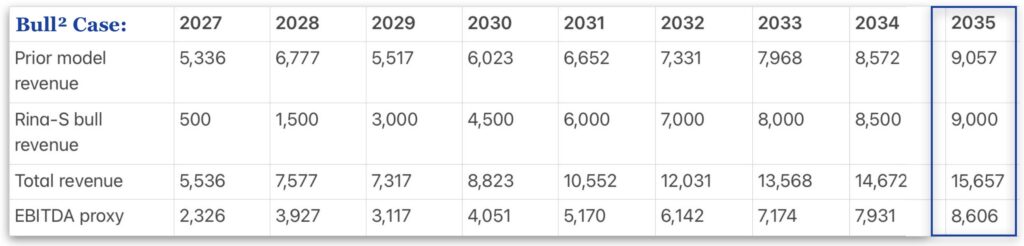
In the bull² scenario, the Dara patent cliff essentially disappears from the long-term Genmab investment thesis.
The current Rina-S trials are still specific cancer-indication trials. The RAINFOL-07 is testing Rina-S ± bevacizumab against platinum-based chemotherapy in second-line platinum-sensitive ovarian cancer. The bull² thesis requires three things:
- The drug works across FRα expression levels. This is the biggest clue so far. Genmab reported a 50% confirmed ORR in heavily pretreated endometrial cancer regardless of FRα expression. If this holds up in larger trials, FRα stops being a narrow biomarker. That potentially changes the addressable population dramatically.
- The therapeutic window is substantially better than conventional chemotherapy. This is absolutely critical. The “next-generation chemo” bull case requires: similar or better efficacy + materially better tolerability. If Rina-S can be used earlier and more broadly because physicians are less concerned about cumulative toxicity, then the market expands by replacing conventional chemotherapy in treatment algorithms.
- It becomes a combination backbone. This is another part the market underestimates. Rina-S is already being evaluated with bevacizumab in ovarian cancer, and Genmab is clearly pursuing combination development. The real bull case is: Rina-S + immunotherapy / anti-angiogenic therapy / other targeted agents. Once oncologists start thinking of Rina-S like they think of paclitaxel or platinum chemo — as backbone — then $9 bln peak sales becomes realistic.
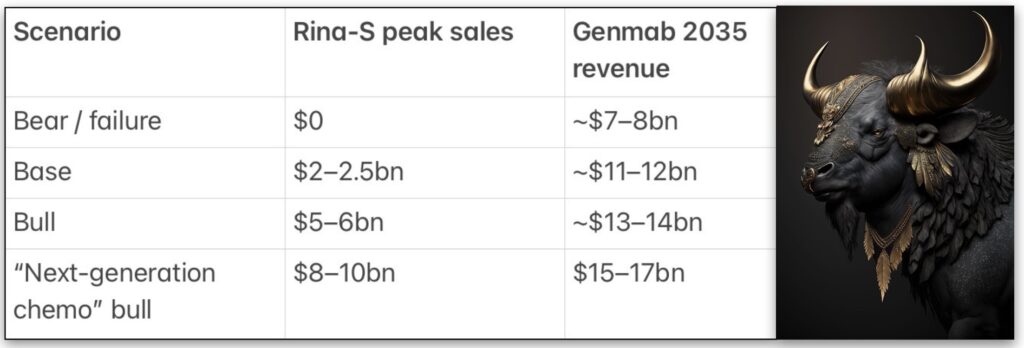
For the market, the $8–10 bln Rina-S scenario is a low probability — but as soon as the data support it, Genmab is not a normal pharma valuation narrative anymore. At that point, Genmab will be valued on $8 bln+ EBITDA potential, and no longer on its current Darzalex patent cliff.
The crucial distinctions: A successful Rina-S is worth $2-3 billion peak sales, whereas a broadly applicable, well-tolerated chemo replacement could be worth $10 billion+. Add Peto that proves it can meaningfully control metastatic disease and you got a $100 billion company. Those are the real asymmetries embedded in the Genmab narrative.
——————————
(*) I haven’t even talked about Genmab’s SLITRK6 ADC, which could also contribute substantially in a few years.
Expression of SLITRK6 in Bladder/Urothelial Cancer:
• SLITRK6 is highly expressed in urothelial carcinoma tissues, including urinary bladder cancers. One study found strong SLITRK6 expression in the majority of bladder urothelial carcinoma (UBUC) and upper tract urothelial carcinoma (UTUC) samples, with expression higher in upper tract tumors than in bladder tumors.
• Large tissue analyses show SLITRK6 positivity in ~88–90% of bladder cancer specimens, often with moderate to strong staining on tumor cells.
• Normal expression of SLITRK6 is relatively low in most tissues but is enhanced in bladder urothelial cells.